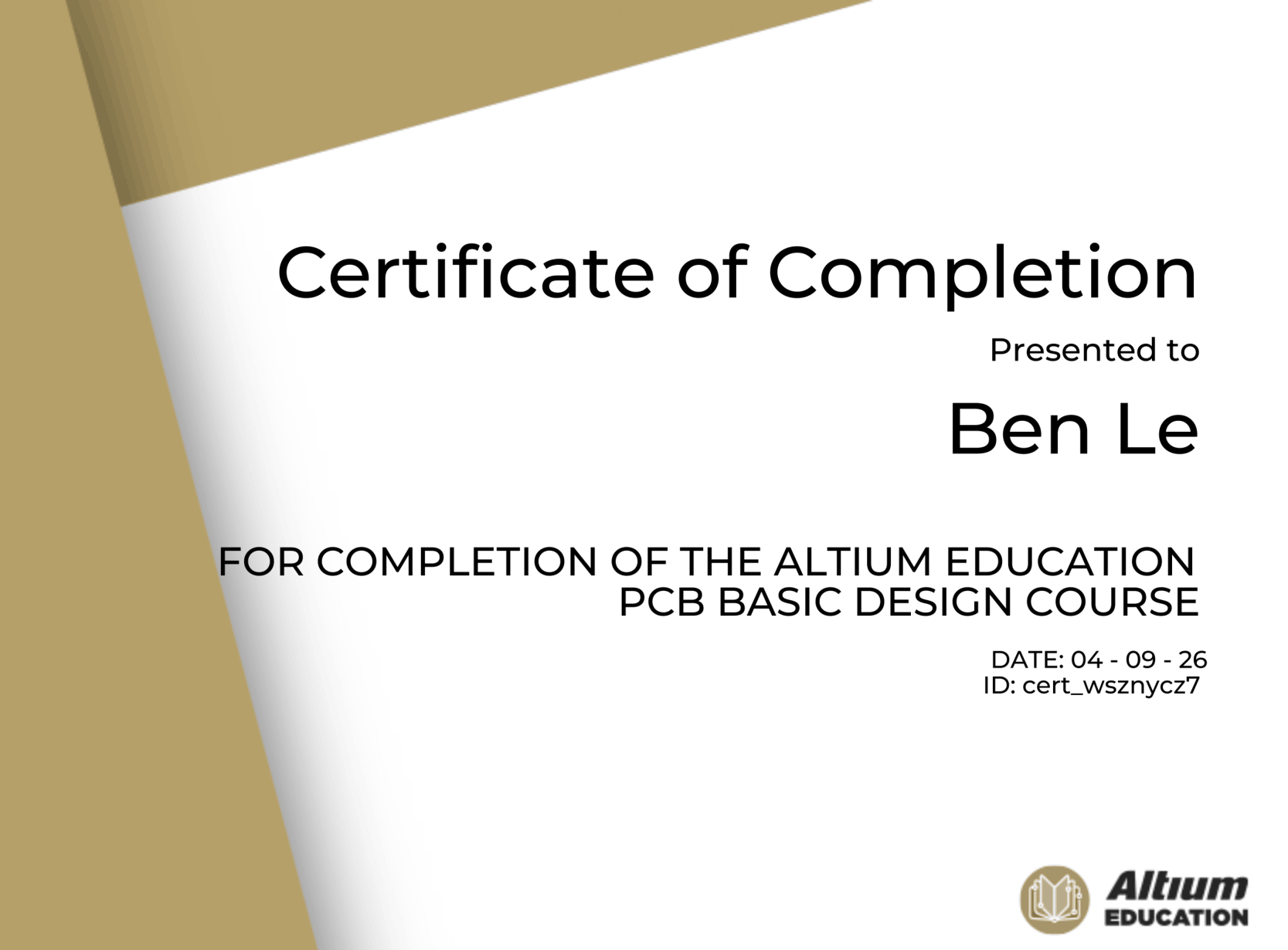
It took me a while, but I finally completed all of the units for Altium's Education guide.
Finishing all six units made me realize that PCB design was entirely different from what I envisioned. No university coursework went over the design process, so I came into this with two naive assumptions: schematic building would be the difficult part, and PCBs are just permanent breadboards. It turns out, that schematic building was a mere two paragraphs of text, while the PCB layout, part selection, and manufacturing design rule checks made up the other 90% of the work.
The thing that gave me the most whiplash was realizing that elements of electrical engineering can be found across multiple disciplines of engineering. While I was studying for the FE, I figured that I would never need to learn about transmission lines again in the future because they're only found when delivering power. I was very wrong—you have to worry about transmission lines even within tiny PCBs because of the relationship between rise times and capacitance, and having feedback means that the signals you're trying to send/receive become distorted.
Overall, I really liked learning how to use Altium, although I still dreaded having to import CAD files into my schematic manually for active parts. I definitely respect PCB designers a lot more, and will be putting ground planes in my PCB designs in the future (because they are not glorified breadboards).